London Street View - Harold Pinter Theatre
Panton Street
London, SW1Y 4DN

Welcome to London! Your Guide to London. The All About London Team has lived and worked in London for many years. We have detailed knowledge of London, feel free to ask us about Places to visit, places to stay and things to do. London Tours, Attractions, Hotels, Accommodation, Events, Theatre, Shows and Places to eat.
Showing posts with label Street View Google. Show all posts
Showing posts with label Street View Google. Show all posts
Monday, 1 June 2015
Tuesday, 26 May 2015
Take a Look At A London Street - Shaftesbury Theatre London, WC2H 8DP
Street View Look At London -Shaftesbury Theatre
London, WC2H 8DP


Saturday, 23 May 2015
Tuesday, 24 July 2012
London Street View- York Watergate
 The mansions facing in the Strand were built where they were partly because they had direct access from their garden fronts to the Thames, which was then a preferred transport artery. The York Watergate (also known as Buckingham Watergate), built ca. 1626, survives, now marooned 150 yards (137 m) from the river, within the Embankment Gardens, due to the construction of the Thames Embankment. With the Banqueting House it is one of the few surviving reminders in London of the Italianate court style of Charles I
View Larger Map
The View from Embankment gardens
View Larger Map
The Rear View at Buckingham Street

View Larger Map
The View from Embankment gardens
View Larger Map
The Rear View at Buckingham Street
Wednesday, 27 June 2012
London View- Holborn Viaduct


View Larger Map
Our Thanks to Victorian Web Visit Their Website
Viaduct from Farringdon Street (looking north)
Holborn Viaduct photographed from below on Farringdon Street, looking north; it crosses the road obliquely, hence its description as a "skew" bridge. The building on the far side of the viaduct, on the right, is now being redeveloped, so there is currently no access to the viaduct at this corner.


Left to right: (a) City of London arms at the centre of the viaduct, with the City of London motto, "Domine Dirige Nos" ("Dirige" can be seen at the base). (b) Close-up of ironwork on one of the shorter spans.
Holborn Viaduct (built 1863-69) is taken for granted now by the many who pass over it every day, or work in the offices along its approach. People arrange to meet at various points on it (under the statues of Agriculture, say, or Commerce) without a thought. But the viaduct was a massive project at the time, "the most ambitious and costly improvement scheme of the [nineteenth] century" (White 47), and it involved some outstanding feats of Victorian engineering.
Built to span the valley of the old River Fleet, which was covered in and channelled underground during the eighteenth century, it was part of a development entailing much demolition and litigation as well as new construction. The plan included not only Farringdon Street over the Fleet, but also Holborn Circus, Charterhouse Street and St Andrew Street. The intention was both to give better access to the City and Smithfield Market at the north-west approach, and to counterpoint Bazalgette's Thames Embankment scheme. With its "iron girder skew bridge, borne on granite pillars," the new arrangement was seen as "the City's showpiece contribution to the Victorian modernisation of the capital" (Ward-Jackson 206). The name of the engineer, given in the inscription on one of the base pillars, was William Haywood (in some sources spelt Heywood), who served ably for 49 years as the Chief Engineer to the City Commissioners of Sewers. Note that after the River Fleet was covered over, it was used as a sewer, a purpose it still serves today. "Holborn Viaduct was not just a raised road," explains James Stevens Curl:
Two lateral arched passages on either side supported the pavements, while the main carriageway lay between these. The vaulted passageways were divided into storeys. First was a space for cellars of the adjoining buildings, then against these was at the top a subway in which were laid the gas-, Water-, and telegraph-pipes; then a passage, and below this a vaulted chamber at the bottom of which was a main sewer. Ventilation of the underground passages was cunningly provided within the pedestals of the cast-iron lampposts. A large tunnel and a subway for pneumatic dispatch-tubes were also incorporated.
The architectural details of this grand project were "handled superbly well, especially where cast-iron arches meet granite columns above exquisite gilded metal capitals that begin to herald Art-Nouveau forms, " continues Curl (226). At the time as well, much praise was given to the ironwork, which was perceived to be "throughout of a far higher character of architectural richness than has been introduced into any other similar structure" (Art Journal, qtd. in Ward-Jackson 209).
The Step-Buildings


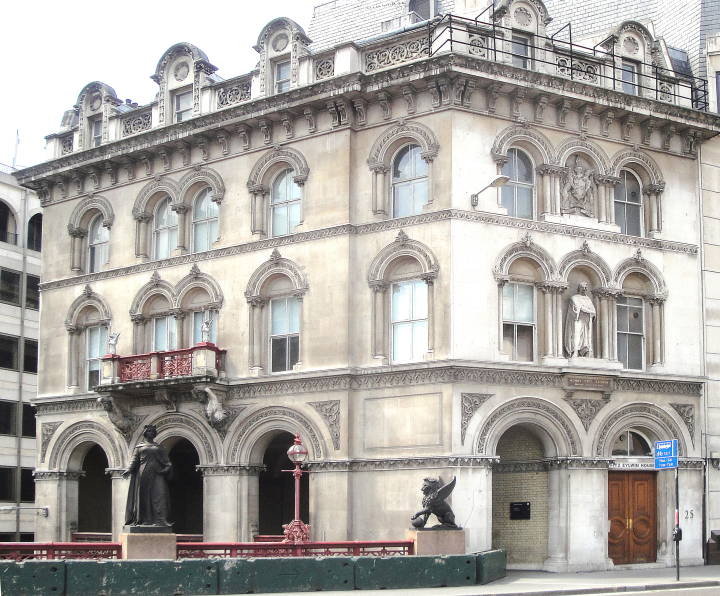
Left to right: (a) One of the step-buildings from the side. (b) Façade of the reconstructed step-building. (c) Both façades of one of the step-buildings, showing balcony on one façade, and niche with a figure of Henry Fitz Eylwin on the other.
Originally, two structures were built at each end of the main part of the viaduct, to house steps from Farringdon Street to the thoroughfare above. Two of the four were badly damaged in World War II; one of these has since been rebuilt as part of the redevelopment of the large office block here, completed in 2001. The structures have been variously described as "Italian Gothic" (Weinreb et al. 406) or, like the figures on their façades) "classico-Renaissance" (Read 269).
They have matching ironwork picked out in red, and architectural sculpture by Henry Bursill, including Atlantes holding up the balconies, and statues in the niches on their front elevations.


Two left: One of the step buildigs with the Atlantes supporting the balcony. Right: Henry Fitz Eylwin [or FitzAlwyn], Mayor 1120 to 1212 by Henry Bursill. 1869. 2 m. high. This last in its architectural surroundings.
Bursill was also responsible for two of the bronze statues on the viaduct itself. Little is known of this sculptor except the dates between which he worked; it is presumed that he was the same Henry Bursill who wrote the popularHand Shadows to be Thrown upon the Wall (Griffith & Farran, 1859), available offsite here, and recently reprinted by Dover.
Left two: Sir Thomas Gresham Born c. 1519, Died 1579. 1869. Right, two: Sir William Walworth, [Lord Mayor] 1370[?] or 1374 to 1375 and 1380 to 1381. [Note: these names and dates are transcriptions of the gilt letters and numbers on a polished dark marble or granite plaque that appears beneath the base of each statue; see the enlarged versions of images at left and right.] 1869, 2000. Both originally by Bursill.
The figures on the front of the step-buildings are representations of important Londoners. Sir William Walworth, shown on the reconstructed step-building here, was Lord Mayor of London twice during the fourteenth century and is best known for having dispatched Wat Tyler at the time of the Peasants' Revolt in 1381 (perhaps a warning to the unrulier element in Victorian society?). The sculpture may not follow the original design very accurately (Ward-Jackson 211), but it has certainly helped to restore this part of the viaduct to its pre-war appearance. The step-building itself is an improvement, since it now has a lift as well as steps!
Sculpture on the Viaduct by Farmer and Brindley
Left two: Views of Fine Art from two different angles. Right: Three views of Science holding a speed governor or controller.
Sculpture on the Viaduct by Henry Bursill (fl. 1855-1870), and the Opening Ceremony
Left to right: (a) Close-up of Commerce. (b) Commerce, centre, and Agriculture left. (c) Agriculture with her scythe [detail of agriculture]
The four winged lions at the ends of the viaduct, each with its left paw resting on a small globe, were by Farmer & Brindley, as were the two female figures on the north side, representing Science and Fine Arts. Bursill's figures on the south side, shown here, are rather finer. These are female too and represent Commerce and Agriculture. Commerce wears a mural crown which suggests the status and fortune of the city. She holds coins and gold in one hand, while the other hand is stretched out in welcome. At her feet are the keys of the city and a parchment offering the freedom of the city (see Ward-Jackson 214). Agriculture's crown is fashioned of olive leaves, and her robe is fringed with oak leaves. Beside her grows corn mixed with poppies.

One of the winged lions by Farmer & Brindley.
The opening of the viaduct by Queen Victoria, which took place on the same day as the opening of the new Blackfriars Bridge, was a splendid occasion. First, "the combined royal and civic processions passed up Farringdon Street amidst an immense assemblage of people, the roadway in the middle being kept clear by soldiers and policemen. The Queen's carriage stopped for a moment before the Viaduct Bridge that Her Majesty might observe the structure from below." Then the procession passed to the other side, taking in Smithfield Market, "which was gorgeously decorated with flags and streamers." Past cheering schoolchildren on either side, it then approached the east end of the viaduct:
Two colossal plaster statues, one bearing the palm of Victory, the other the olive-branch of Peace, were set up at the entrance, and numerous banners helped the general effect. Along the level approach to the Viaduct, which was from end to end strewn with yellow sand, seats were placed under cover, and in well-arranged blocks, for the guests of the Corporation. Above these streamed in the fresh breeze bannerets of the dagger and St. George's Cross on a white ground, from days immemorial the arms of the City of London; and the masts to which they were attached, were painted and gilt. The pavilion, which had seats for 600 spectators, was constructed of red and white striped canvas at the sides, but of gold coloured hangings, with devices in colour at the end, and with curtains of maroon to keep out the draughts.
At last everyone was assembled inside the lavishly decorated pavilion. "When Her Majesty reached the platform and the carriage halted, the Lord Mayor presented Mr Deputy Fry and Mr Haywood, the engineer of the viaduct. Mr Fry then handed to the Queen a volume elaborately bound in cream-coloured morocco, relieved with gold, and ornamented with the Royal arms of England, in a mosaic of leather and gold; and Her Majesty declared the viaduct open for public traffic" (Thornbury). It was considered a truly historic day for the City.
After that, however, the viaduct swiftly blended into the cityscape. As a commentator in The Builder wrote soon afterwards, "The improvement is so grand and yet so simple, and the direction taken by the new road is so obviously the easiest and the best, that difficulties of construction and engineering details are in a manner lost sight of, and it is not until the work concealed from the eye is dived into, that the true nature of the undertaking is understood" (qtd. in Thornbury). More recently, and perhaps still without due recognition of all that was involved in its construction, Holborn Viaduct has been dubbed the world's first flyover (Bullus & Asprey 242).
Photographs by Jacqueline Banerjee, Ph.D., Associate Editor, The Victorian Web, and Robert Freidus. Text by JB.
References
Bullus, Claire, and Ronald Asprey. Statues of London, with photographs by Dennis Gilbert. London &: New York, Merrell, 2009.
Curl, James Stevens. Victorian Architecture. Newton Abbot: David & Charles, 1990.
Read, Benedict. Victorian Sculpture. New Haven & London: Yale University Press, 1982.
Thornbury, Walter. "Farringdon Street, Holborn Viaduct and St Andrew's Church" (from Old and New London, Vol. 2, 1878). British History Online. Viewed 3 May 2010.
Ward-Jackson, Philip. Public Sculpture of the City of London. Liverpool: Liverpool University Press, 1990.
Weinreb, Ben, Christopher Hibbert, Julia Keay and John Keay, eds. The London Encyclopaedia. 3rd ed. London: Macmillan, 2008.
White, Jerry. London in the Nineteenth Century: "A Human Awful Wonder of God." London: Cape, 2007.
View Larger Map
Our Thanks to Victorian Web Visit Their Website
London View-

View Larger Map
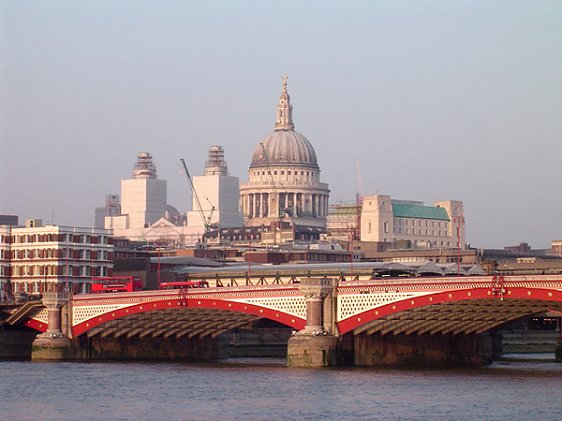
Blackfriars Bridge

The first fixed crossing at Blackfriars was a 995 feet (303 m) long toll bridge designed in an Italianate style by Robert Mylne and constructed with nine semi-elliptical arches of Portland stone. Beating designs by John Gwynn and George Dance, it took nine years to build, opening to the public in 1769. It was the third bridge across the Thames in the then built-up area of London, supplementing the ancient London Bridge, which dated from several centuries earlier, and Westminster Bridge. It was originally named "William Pitt Bridge" (after the Prime Minister William Pitt) as a dedication, but its informal name relating to the precinct within the City named after the Blackfriars Monastery, a Dominican priory which once stood nearby, was generally adopted.
Although it was built of Portland stone the workmanship was very faulty. Between 1833 and 1840 extensive repairs were necessary, and a good deal of patching-up was done, until at last it was decided to build a new bridge on the same site and this coincided with the creation of the Thames Embankment's junction with the new Queen Victoria Street required a major reconfiguration. This is the present bridge which in 1869 was opened by Queen Victoria.
The present bridge is 923 feet (281 m) long, consisting of five wrought iron arches built to a design by Thomas Cubitt. Cubitt also designed the adjacent rail bridge (now demolished) and it was a condition that the spans and piers of the two bridges be aligned. It was built by P.A. Thom & Co. Like its predecessor it is owned and maintained by the Bridge House Estates, a charitable trust overseen by the City of London Corporation. Like London Bridge the full length and its southern end is within the City's borders and not in the adjoining borough of Southwark. Due to the volume of traffic over the bridge, it was widened between 1907–10, from 70 feet (21 m) to its present 105 feet (32 m).
The bridge became internationally notorious in June 1982, when the body of Roberto Calvi, a former chairman of Italy's largest private bank, was found hanging from one of its arches with five bricks and around $14,000 in three different currencies in his pockets. Calvi's death was initially treated as suicide, but he was on the run from Italy accused of embezzlement and in 2002 forensic experts concluded that he had been murdered by the Mafia, to whom he was indebted. In 2005, five suspected members of the Mafia were tried in a Rome court for Calvi's murder, but all were acquitted in June 2007 for lack of evidence.
Thanks To Wikipedia

View Larger Map
Tuesday, 20 March 2012
What's That in London Kingsway Tramway Subway

The Kingsway Tramway Subway is a cut-and-cover Grade II Listed tunnel in central London, built by the London County Council, the only one of its kind in Britain. The decision in 1898 to clear slum districts in the Holborn area provided an opportunity to use the new streets for a tramway connecting the lines in the north and south and, following the pattern of tramway systems in New York (the Murray Hill Tunnel) and Boston (the MBTA Green Line), it was decided to build this as an underground connection.
Wikipedia
View Larger Map

The Kingsway Tramway Subway is a cut-and-cover Grade II Listed tunnel in central London, built by the London County Council, the only one of its kind in Britain. The decision in 1898 to clear slum districts in the Holborn area provided an opportunity to use the new streets for a tramway connecting the lines in the north and south and, following the pattern of tramway systems in New York (the Murray Hill Tunnel) and Boston (the MBTA Green Line), it was decided to build this as an underground connection.
Wikipedia
View Larger Map
Saturday, 21 January 2012
Today's Featured Blue Plaque Enid Blyton
BLYTON, Enid (1897-1968)
ENID BLYTON 1897-1968 Children's Writer lived here 1920-1924 207 Hook Road, , KT9 1EA. Take a walk down a London Street and see where she lived
View Larger Map
Wikipedia View
BLYTON, Enid (1897-1968)
ENID BLYTON 1897-1968 Children's Writer lived here 1920-1924 207 Hook Road, , KT9 1EA. Take a walk down a London Street and see where she lived
View Larger Map
Wikipedia View
Enid Blyton (11 August 1897 – 28 November 1968) was a British children's writer also known as Mary Pollock.
She is noted for numerous series of books based on recurring characters and designed for different age groups. Her books have enjoyed huge success in many parts of the world, and have sold over 600 million copies.[1]
One of Blyton's most widely known characters is Noddy, intended for early years readers. However, her main work is the genre of young readers' novels in which children have their own adventures with minimal adult help. Series of this type include the Famous Five (21 novels, 1942–1963, based on four children and their dog), the Five Find-Outers and Dog, (15 novels, 1943–1961, where five children regularly outwit the local police) as well as The Secret Seven (15 novels, 1949–1963, a society of seven children who solve various mysteries).
Her work involves children's adventure stories, and fantasy, sometimes involving magic. Her books were and still are enormously popular throughout the Commonwealth and in the Republic of Ireland; as translations in Japan and the former Yugoslavia; as adaptations in Arabic; and across most of the globe. Her work has been translated into nearly 90 languages.
Blyton's literary output was of an estimated 800 books over roughly 40 years. Chorion Limited of London now owns and handles the intellectual properties and character brands of Blyton's Noddy and the well known series the Famous Five.
Friday, 20 January 2012
Today's Featured Blue Plaque Bejamin Britten BRITTEN, Benjamin, O.M. (1913-1976)
BENJAMIN BRITTEN O.M. 1913-1976 Composer lived here 1931-1933 173 Cromwell Road, South Kensington, SW5 0SE
View Larger Mapp
Wikipedia View More
Edward Benjamin Britten, Baron Britten, OM CH (22 November 1913 – 4 December 1976) was an English composer, conductor, and pianist; and one of the central figures of 20th century British classical music. He showed talent from an early age, and first came to public attention with the a cappella choral work A Boy Was Born in 1934. With the premiere of his opera Peter Grimes in 1945, he leapt to international fame. For the next fifteen years he devoted much of his compositional attention to writing operas, establishing him as one of the leading 20th century figures in this genre. Britten's interests as a composer were wide-ranging; he produced important music in such varied genres as orchestral, choral, solo vocal (much of it written for his life partner, tenor Peter Pears), chamber and instrumental, as well as film music. He also took a great interest in writing music for children and amateur performers, and was an outstanding pianist and conductor.

Thursday, 19 January 2012
Today's Featured Blue Plaque Isambard Kingdom Brunel.
Today's Featured Blue Plaque Isambard Kingdom Brunel.
BRUNEL, Isambard Kingdom (1806-1859) & BRUNEL, Sir Marc Isambard (1769-1849)SIR MARC ISAMBARD BRUNEL 1769-1849 and ISAMBARD KINGDOM BRUNEL 1806-1859 civil engineers lived here
98 Cheyne Walk, Chelsea, SW10 0DQ take a walk down a London Street on Street View.
View Larger Map
Wikipedia View
BRUNEL, Isambard Kingdom (1806-1859) & BRUNEL, Sir Marc Isambard (1769-1849)SIR MARC ISAMBARD BRUNEL 1769-1849 and ISAMBARD KINGDOM BRUNEL 1806-1859 civil engineers lived here
98 Cheyne Walk, Chelsea, SW10 0DQ take a walk down a London Street on Street View.
View Larger Map
Wikipedia View
Isambard Kingdom Brunel, FRS (9 April 1806 – 15 September 1859), was a British civil engineer who built bridges and dockyards including the construction of the first major British railway, the Great Western Railway; a series of steamships, including the first propeller-driven transatlantic steamship; and numerous important bridges and tunnels. His designs revolutionised public transport and modern engineering.
Though Brunel's projects were not always successful, they often contained innovative solutions to long-standing engineering problems. During his short career, Brunel achieved many engineering "firsts", including assisting in the building of the first tunnel under a navigable river and development of SS Great Britain, the first propeller-driven ocean-going iron ship, which was at the time (1843) also the largest ship ever built.
Brunel set the standard for a very well built railway, using careful surveys to minimise grades and curves. This necessitated expensive construction techniques and new bridges and viaducts, and the two-mile-long Box Tunnel. One controversial feature was the wide gauge, a "broad gauge" of 7 ft 0 1⁄4 in (2,140 mm), instead of what was later to be known as 'standard gauge' of 4 ft 8 1⁄2 in (1,435 mm). The wider gauge added to passenger comfort but made construction much more expensive and caused difficulties when eventually it had to interconnect with other railways using the narrower gauge. As a result of the Railway Regulation (Gauge) Act 1846 (and after Brunel's death) the gauge was changed to standard gauge throughout the GWR network.


Wednesday, 18 January 2012
Today's featured Blue Plaque Richard Clement Attlee Prime Minister
ATTLEE, Richard Clement (1883-1976)CLEMENT RICHARD ATTLEE 1883-1967 Prime Minister lived here Take a quick view down a London Street and look where he lived.
17 Monkhams Avenue, , IG8 0HB
View Larger Map
Wikipedia
Clement Richard Attlee, 1st Earl Attlee, KG, OM, CH, PC, FRS (3 January 1883 – 8 October 1967) was a British Labour politician who served as the Prime Minister of the United Kingdom from 1945 to1951, and as the Leader of the Labour Party from 1935 to 1955. He was also the first person to hold the office of Deputy Prime Minister, under Winston Churchill in the wartime coalition government, before leading the Labour Party to a landslide election victory over Churchill's Conservative Party in 1945. He was the first Labour Prime Minister to serve a full Parliamentary term, and the first to command a Labour majority in Parliament.
Tuesday, 17 January 2012
Today's Featured Blue Plaque William Bligh
BLIGH, William (1754-1817)WILLIAM BLIGH 1754-1817 COMMANDER OF THE "BOUNTY" LIVED HERE 100 Lambeth Road, Lambeth, SE1 7PT
Take a quick view down a London Street and look where William Bligh lived
View Larger Map
Wikipedia More
Vice Admiral William Bligh FRS RN (9 September 1754 – 7 December 1817) was an officer of the British Royal Navy and a colonial administrator. A notorious mutiny occurred during his command of HMAVBounty in 1789; Bligh and his loyal men made a remarkable voyage to Timor, after being set adrift in the Bounty's launch by the mutineers. Fifteen years after the Bounty mutiny, he was appointed Governor of New South Wales in Australia, with orders to clean up the corrupt rum trade of the New South Wales Corps, resulting in the so-called Rum Rebellion.

About Blue Plaques
BLIGH, William (1754-1817)WILLIAM BLIGH 1754-1817 COMMANDER OF THE "BOUNTY" LIVED HERE 100 Lambeth Road, Lambeth, SE1 7PT
Take a quick view down a London Street and look where William Bligh lived
View Larger Map
Wikipedia More
Vice Admiral William Bligh FRS RN (9 September 1754 – 7 December 1817) was an officer of the British Royal Navy and a colonial administrator. A notorious mutiny occurred during his command of HMAVBounty in 1789; Bligh and his loyal men made a remarkable voyage to Timor, after being set adrift in the Bounty's launch by the mutineers. Fifteen years after the Bounty mutiny, he was appointed Governor of New South Wales in Australia, with orders to clean up the corrupt rum trade of the New South Wales Corps, resulting in the so-called Rum Rebellion.
About Blue Plaques
Tuesday, 11 October 2011
Wednesday, 5 October 2011
Thursday, 29 September 2011
Subscribe to:
Posts (Atom)